
Full and partial vinyl chip broadcast
Flake Garage Floors in Salt Lake City, UT
A textured, speckled finish that hides the white salt film and gray grit of a Wasatch Front winter.
- Free estimates on site: we measure your slab and inspect it in person
- A moisture reading on the slab before we put down a single coat
- A written quote that explains every surface prep step
Why So Many Garages End Up With Flake
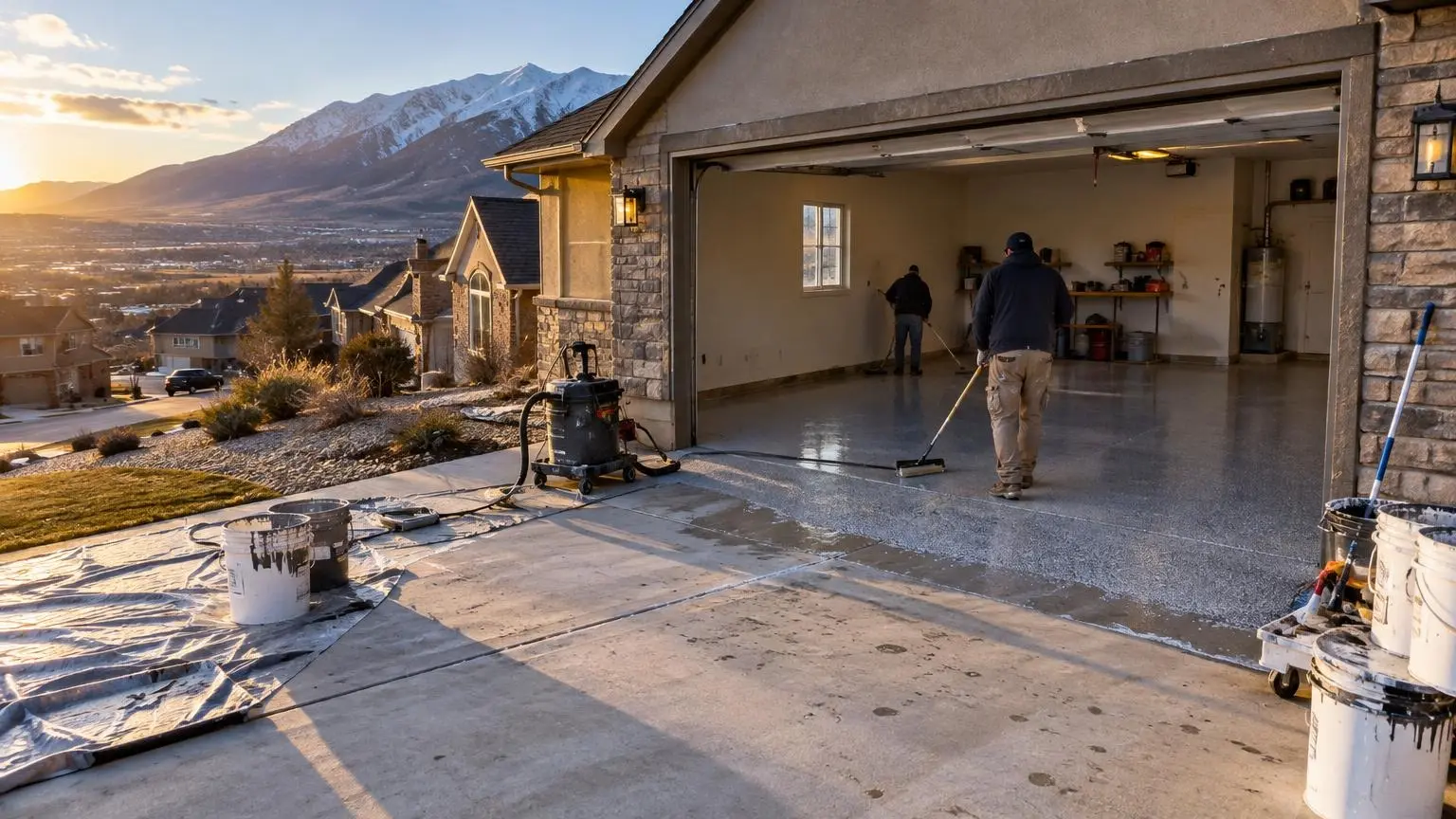
Flake garage floors are the most practical finish we install in Salt Lake City, and for one simple reason: they hide winter. When snowmelt dries on a garage floor it leaves a pale salt film, sand from the roads and tire tracks. On a solid-color floor every bit of it shows. A flake epoxy floor, built from colored vinyl chips broadcast into a wet base coat and locked under a clear topcoat, breaks up the surface so that film and grit blend in between cleanings. Epoxy Flooring Salt Lake City installs full and partial flake systems in garages, workshops, mudrooms and basements.
What a chip floor is made of
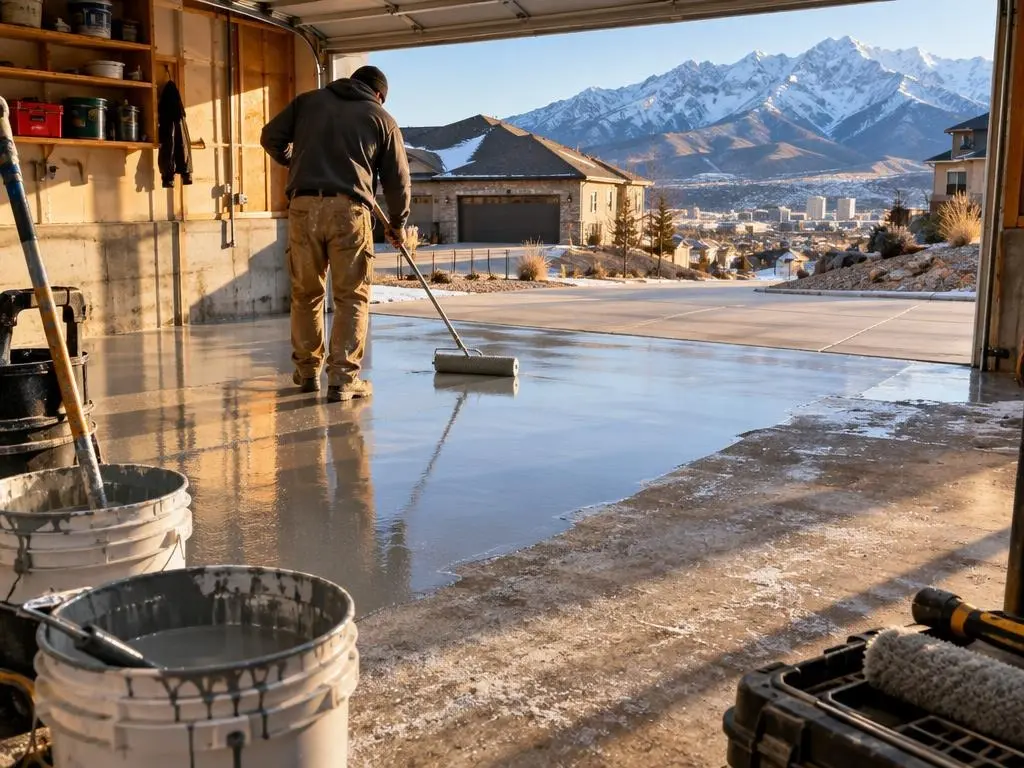
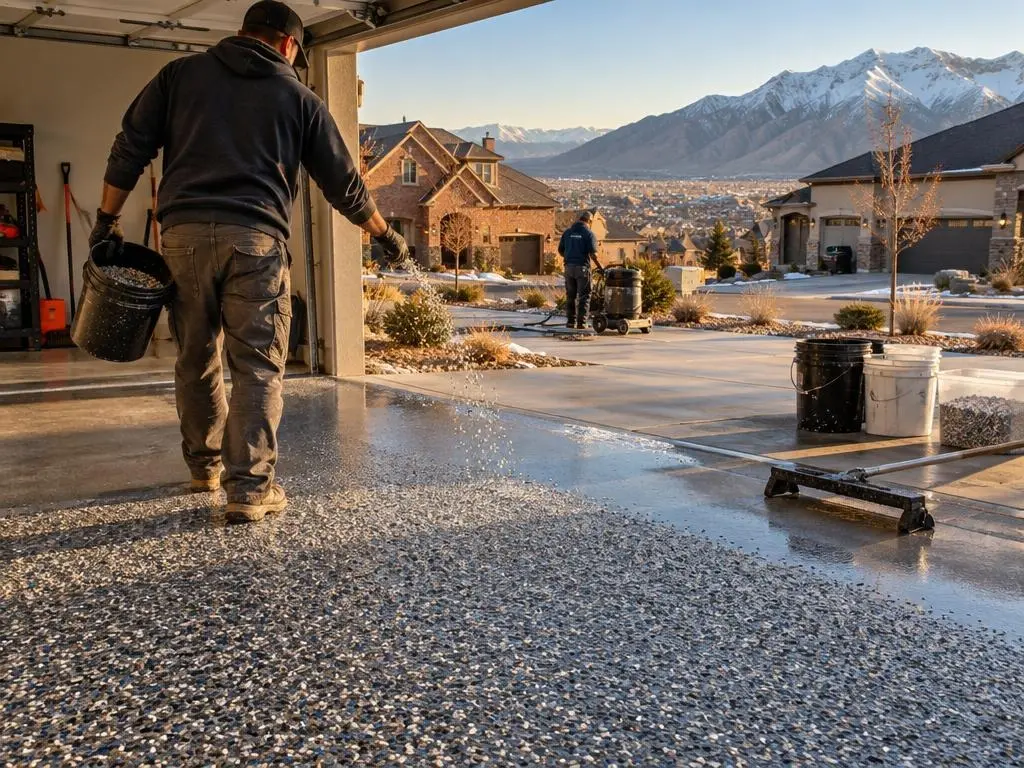
A flake floor has three working layers. First a base coat goes down over diamond-ground concrete. While it is still wet, vinyl chips are thrown across the surface by hand, either until the floor is covered completely (a full broadcast) or in a lighter scatter (a partial broadcast). After the base has hardened, we scrape away the chips that did not stick and vacuum them up, and the floor is sealed with one or two clear topcoats. The chips are what you see. The topcoat is what you walk on and what keeps salt, oil and water out.
Full broadcast or partial?
With a full broadcast, chip covers every inch, so you get the most texture and the best at hiding dirt. It also adds body to the system, since the chips themselves build thickness. A partial broadcast shows more of the base color underneath and has a cleaner, simpler look, with a little less texture. In a garage that sees heavy slush, we usually recommend a full broadcast, at least near the door. In a basement or a gym, partial flake is often plenty.
Coverage also affects cleaning. A full broadcast with a moderate topcoat has a fine texture that grips well but holds a little more dirt in its surface, so a soft deck brush works better than a mop. A partial broadcast with more topcoat is smoother and mops easily. Neither is wrong. It depends on whether grip or quick cleanup matters more in your space, and we will show you both on sample boards.
Grip where the snow melts
Salt Lake City averages about 127 days a year at or below freezing, and snow can fall from early November into April. That means months of melting snow dripping from wheel wells onto the floor. A chip floor has a natural orange-peel texture once the topcoat goes on. How rough it feels depends on how much topcoat we apply: fewer coats leave more texture and grip, more coats make it smoother and easier to mop. We help you pick a balance, and for steps and entry areas we can mix fine anti-slip grit into the last coat.
Picking a blend
Chip blends come in many sizes and color mixes. Small chips read as a fine granite texture, while larger chips look bolder. For Salt Lake garages, mid-tone gray, tan and mixed blends tend to work hardest because they hide both the white of dried salt and the dark of tire marks. Very dark blends show salt; very light ones show tires. Sample boards come with us on the estimate visit, so you can lay them on your actual slab under your actual lighting before you commit.
Light also changes how a blend reads. A garage lit by one bulb looks very different from one with bright LED shop lights, and a basement with small windows will make any blend look darker than it does outside. That is why we bring physical samples rather than relying on a screen, and why we suggest looking at them at the time of day you use the space most.
The topcoat on a flake floor
The clear coat over the chips is where most of the durability lives. We usually use a polyaspartic topcoat on garage flake floors. HomeGuide gives polyaspartic an excellent UV rating, against poor to fair for ordinary epoxy, so it will not yellow where the sun reaches through an open door, and it holds up to the chemicals and brine that ride in on cars. On basement floors with no sunlight, an epoxy or polyurethane topcoat can also work.
Chips still need a ground slab
Chips do not fix bad prep. The floor still has to be ground to open the surface, repaired where it is cracked or scaled, and tested for moisture before we quote. That matters even more in older neighborhoods, where many garages were built decades ago and carry paint, oil and patchwork. On a newer slab the grinding is quicker, but it is never skipped. Every step is listed in your written quote.
Flake works beyond the garage, too. Mudrooms, laundry rooms, covered entries and basement landings all benefit from a surface that hides dirt and gives some grip. The same prep and the same moisture testing apply in every one of those rooms, and the written quote lists each area separately so you can choose which ones to include.
Flake Floor Options
Each flake floor is built from the same layers, but the chip size, coverage and texture are up to you.
Full chip broadcast
Chips cover the entire base coat for maximum texture and the most forgiving look.
Partial chip broadcast
A lighter scatter that lets the base color show through with a cleaner finish.
Chip size and blend
Fine to large chips in gray, tan, mixed and custom blends, chosen from sample boards.
Clear topcoat
One or two clear coats, usually polyaspartic, that seal the chips and resist salt and UV.
Texture control
Topcoat thickness and optional anti-slip aggregate set how rough or smooth the floor feels.
Typical Flake Floor Costs
| Job | Published range | Source |
|---|---|---|
| Epoxy garage coating, per sq ft | $4 to $10 | HomeGuide |
| Polyaspartic garage coating, per sq ft | $5 to $12 | HomeGuide |
| Two-car garage, polyaspartic | $2,000 to $6,900 | HomeGuide |
| Decorative flakes, material | About $0.04 per sq ft | HomeAdvisor |
| High-grade coating upgrade | Adds 20% to 30% | HomeAdvisor |
| Contractor minimum charge | $500 to $1,000 | HomeAdvisor |
National figures for comparison only. Chip coverage, topcoat count and slab repairs change the price of a flake floor, so we measure first and the number on your written estimate is the one that counts.
How a Flake Floor Goes Down
1. Pick a blend
We look at chip samples together on your slab and talk about texture.
2. Grind and repair
The floor is diamond ground, cleaned and patched, and moisture is tested.
3. Base and broadcast
We roll out a base coat and toss the chips into the wet resin before it sets.
4. Scrape and seal
Once the base hardens, stray chips get scraped and vacuumed up, then the clear topcoat goes on.
5. Cure
We tell you when to walk, store and park based on the topcoat and the temperature.
Why Choose Us for Flake Garage Floors
Samples on your floor
You choose chip blends in your own garage light, not from a small photo.
Texture set for snowmelt
We match topcoat thickness to how much slush your garage sees.
Prep never skipped
Every flake floor is ground and moisture tested first.
Flake Garage Floors Questions
Is a flake floor more slippery than bare concrete?
Usually not. Under the topcoat, the chips create a light texture. For extra grip by the door or on steps, we mix anti-slip grit into the last coat.
Do flake floors show salt stains?
Much less than solid colors. Mid-tone mixed blends hide both dried salt film and tire marks well between rinses.
Does flake flooring work in a basement?
Yes. Partial flake is popular in basements and gyms. The slab still needs grinding and a moisture test before coating.
What is the difference between chip and vinyl flake?
They are the same thing. Chip, flake and vinyl flake all refer to the colored vinyl pieces broadcast into the base coat.
Flake Garage Floors Service Areas
- Epoxy Flooring in Salt Lake City, UT
- Epoxy Flooring in West Valley City, UT
- Epoxy Flooring in Murray, UT
- Epoxy Flooring in Sandy, UT
- Epoxy Flooring in Draper, UT
- Epoxy Flooring in South Jordan, UT
- Epoxy Flooring in West Jordan, UT
- Epoxy Flooring in Taylorsville, UT
- Epoxy Flooring in Holladay, UT
- Epoxy Flooring in Cottonwood Heights, UT
- Epoxy Flooring in Millcreek, UT
- Epoxy Flooring in Midvale, UT
- Epoxy Flooring in Riverton, UT
- Epoxy Flooring in Herriman, UT
- Epoxy Flooring in Bountiful, UT
- Epoxy Flooring in North Salt Lake, UT
- Epoxy Flooring in Woods Cross, UT
- Epoxy Flooring in Centerville, UT
- Epoxy Flooring in Magna, UT
- Epoxy Flooring in Kearns, UT
- Epoxy Flooring in South Salt Lake, UT
- Epoxy Flooring in Bluffdale, UT
- Epoxy Flooring in Lehi, UT
- Epoxy Flooring in Park City, UT
- Epoxy Flooring in Tooele, UT
Get a Flake Garage Floors Estimate
See chip samples on your own slab at a free estimate.