
A quarter of the city's homes predate 1940
Epoxy Flooring in Salt Lake City, UT
Coatings planned around old concrete, long freezing seasons and the salt that rides in on every winter tire.
- Free estimates on site: we measure your slab and inspect it in person
- A moisture reading on the slab before we put down a single coat
- A written quote that explains every surface prep step
Older Concrete Needs a Careful Start
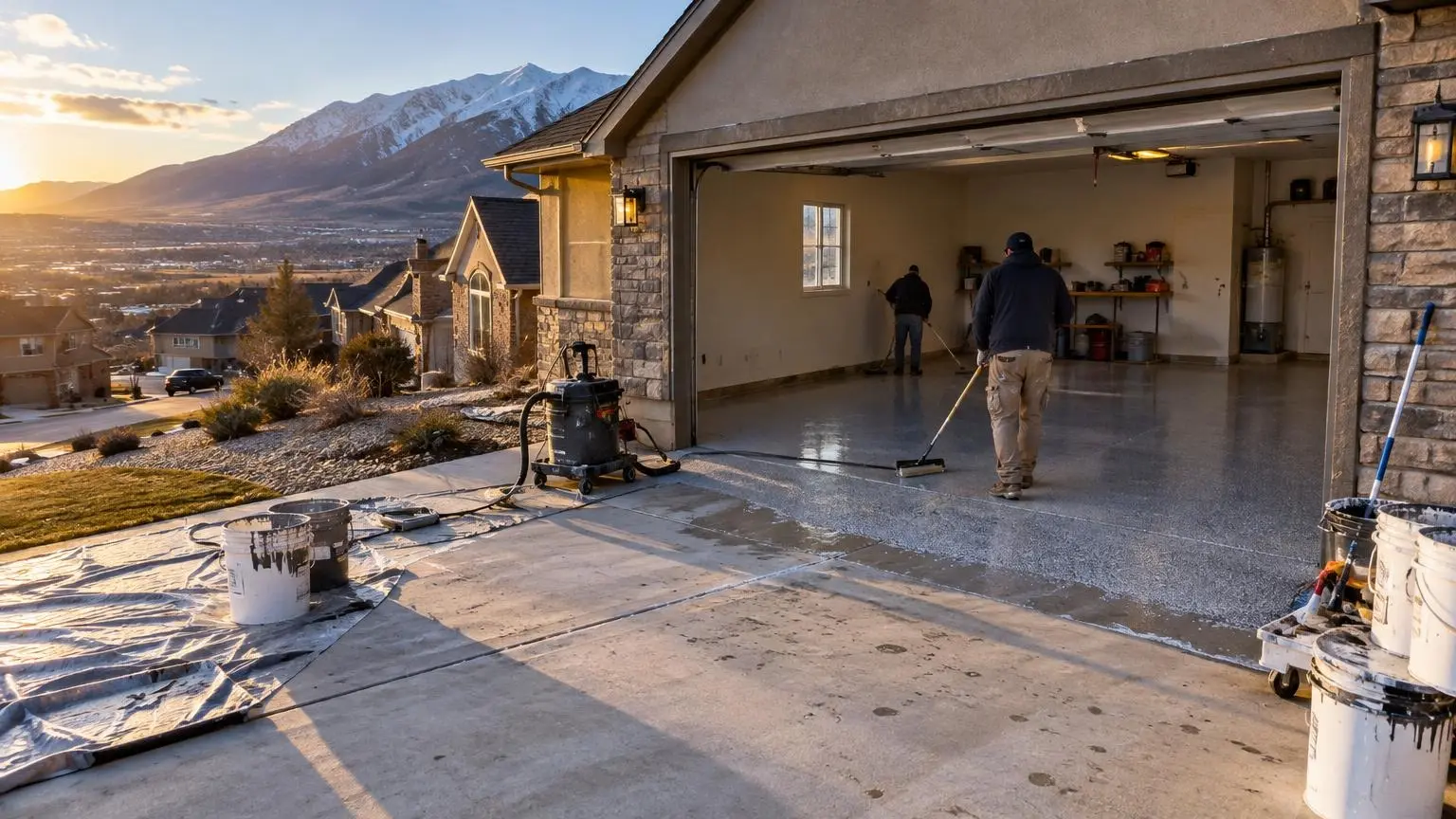
Epoxy flooring in Salt Lake City often goes over concrete that is older than the people parking on it. By Census survey counts, roughly 25.4% of local housing units date to 1939 or before, and Wikipedia notes that many valley homes date from before World War II. A detached garage behind an Avenues or Sugar House bungalow may have decades of oil, paint and patchwork in its surface. We plan every floor around what that slab can actually hold.
What decades of use leave behind
Old garage floors tend to share a few problems. Oil soaks deep into the pores. Earlier owners rolled on porch paint or a hardware-store kit that has since peeled. Hairline cracks run from corners, and some slabs were poured with no vapor barrier at all. Each of these changes the plan. Grinding opens the surface so a primer can bite, crack repair keeps lines from telegraphing through the new finish, and a moisture reading tells us whether a vapor-tolerant primer is needed. You get those steps itemized in writing.
A long season below freezing
Salt Lake City averages about 127 days a year at or below freezing, with snow typically falling from early November to mid-April. UDOT says it spreads about 236,000 tons of salt on state roads over a winter season, and a share of that melts off tire wells onto garage floors. Bare concrete soaks up that brine and can scale over time. A sealed epoxy or polyaspartic surface leaves the salt sitting up top, so a squeegee and a hose can clear it.
Dry summers, quick cures
The city is dry for most of the year. Average relative humidity runs about 55.3% annually and drops to roughly 22% on July afternoons, while summers bring about 56 days at or above 90 degrees. Low humidity helps coatings cure on schedule, but heat shortens working time. On hot days we mix smaller batches and start early, before the slab soaks up the afternoon sun.
Creeks under the streets
City Creek burst its banks in 1952 and again in 1983, when engineers turned several downtown streets into channels for the water. Low-lying basements and garages near old creek routes can carry more ground moisture than you might expect in a dry climate. For that reason too, the test always comes ahead of the quote, and if drainage work has to happen before a coating can last, you hear it from us.
Floors for city businesses
Government, trade, transportation and health services anchor the local economy, and the airport is home to a Delta hub. Shops, clinics, back-of-house rooms and service bays all take heavier wear than a home garage. For those spaces we lean on thicker 100% solids systems, slip-resistant texture and safety striping, and the job can be split into stages so your doors stay open.
Salt Lake City Conditions That Shape a Floor
- Pre-war housing. Homes from 1939 or earlier: about 25.4% of the housing stock (ACS 2019-2023, via Point2Homes).
- Freezing days. The city averages about 127 days a year at or below freezing, with snow from early November into April.
- Winter road salt. UDOT reports using about 236,000 tons of salt on its roads across a winter season.
- Dry summer air. Annual relative humidity averages 55.3%, falling to about 22% on July afternoons.
- Creek flooding. City Creek flooded downtown in 1952 and in 1983, when streets were turned into temporary channels.
Our Services in Salt Lake City, UT
Salt Lake City Questions
Can you coat a detached garage built in the 1920s or 1930s?
Often, yes. Older slabs usually need more grinding and patching, and some lack a vapor barrier. We test moisture first, pick the primer the reading calls for, then explain the prep in your written quote.
Will road salt damage a coated garage floor?
A sealed coating holds salt brine up on the surface so the concrete never drinks it in. Rinsing the floor now and then through winter keeps the finish looking clean.
Is summer a good time to install a floor in Salt Lake City?
It can be. The dry air helps curing, but afternoon heat shortens working time, so we schedule early starts and mix in smaller batches when temperatures climb.
My old garage floor has peeling paint. Do you work over it?
No. Loose paint or a failed kit coating has to come off first, usually by grinding. Fresh resin bonds only as well as the surface beneath it.
Free Estimates in Salt Lake City, UT
Have us look at your Salt Lake City garage, shop or business floor. The estimate costs nothing.
Epoxy Flooring Near Salt Lake City
- Epoxy Flooring in West Valley City, UT
- Epoxy Flooring in Murray, UT
- Epoxy Flooring in Sandy, UT
- Epoxy Flooring in Draper, UT
- Epoxy Flooring in South Jordan, UT
- Epoxy Flooring in West Jordan, UT
- Epoxy Flooring in Taylorsville, UT
- Epoxy Flooring in Holladay, UT
- Epoxy Flooring in Cottonwood Heights, UT
- Epoxy Flooring in Millcreek, UT
- Epoxy Flooring in Midvale, UT
- Epoxy Flooring in Riverton, UT
- Epoxy Flooring in Herriman, UT
- Epoxy Flooring in Bountiful, UT
- Epoxy Flooring in North Salt Lake, UT
- Epoxy Flooring in Woods Cross, UT
- Epoxy Flooring in Centerville, UT
- Epoxy Flooring in Magna, UT
- Epoxy Flooring in Kearns, UT
- Epoxy Flooring in South Salt Lake, UT
- Epoxy Flooring in Bluffdale, UT
- Epoxy Flooring in Lehi, UT
- Epoxy Flooring in Park City, UT
- Epoxy Flooring in Tooele, UT