
One-, two- and three-car garages
Epoxy Garage Flooring in Salt Lake City, UT
A sealed, easy-rinse garage floor for a city that spends five months tracking slush and salt indoors.
- Free estimates on site: we measure your slab and inspect it in person
- A moisture reading on the slab before we put down a single coat
- A written quote that explains every surface prep step
A Garage Floor That Can Take a Utah Winter
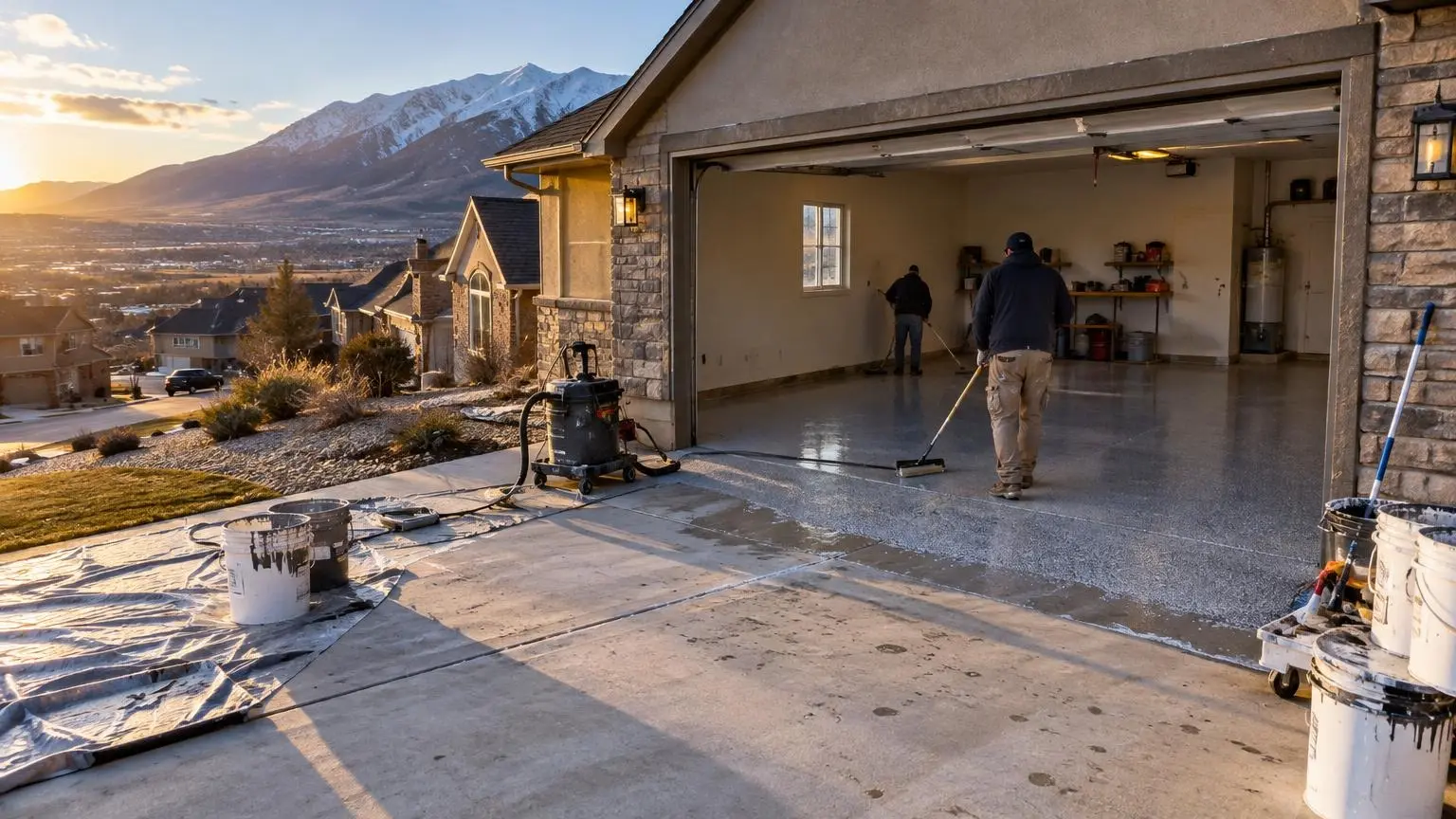
Epoxy garage flooring in Salt Lake City earns its keep between November and April. That is when tires roll in packed with slush, the snow melts into gray puddles under the car, and the salt in that water sits on the concrete for days. An epoxy garage floor puts a continuous, sealed layer over the slab so the mess stays on top. Epoxy Flooring Salt Lake City grinds, repairs and coats one-, two- and three-car garages across the valley, from narrow detached garages behind older city homes to wide attached garages in the newer suburbs.
What salt does to bare concrete
The Utah Department of Transportation reports using about 236,000 tons of salt on its roads over a winter, and the city averages about 127 days a year at or below freezing. Bare concrete is porous. Brine soaks in, freezes, expands, thaws and soaks in again. Over a few winters that cycle can flake off the top of the slab near the door and under the wheels, leaving a rough, pitted surface that holds even more water. A garage floor coating stops the water from getting in at all. With a sealed floor, a squeegee and a hose push melted slush out the door, and the concrete below stays dry.
Salt is not the only thing that rides in. Road sand and grit act like sandpaper under tires and boots, and a snowblower parked by the door drips meltwater all season. Brine pretreatment, which UDOT sprays on roads before storms arrive, dries into a fine white film that shows up as soon as the floor dries. On a coated floor that film wipes away. On bare concrete it keeps working its way into the surface every time it gets wet again.
Why the topcoat matters most
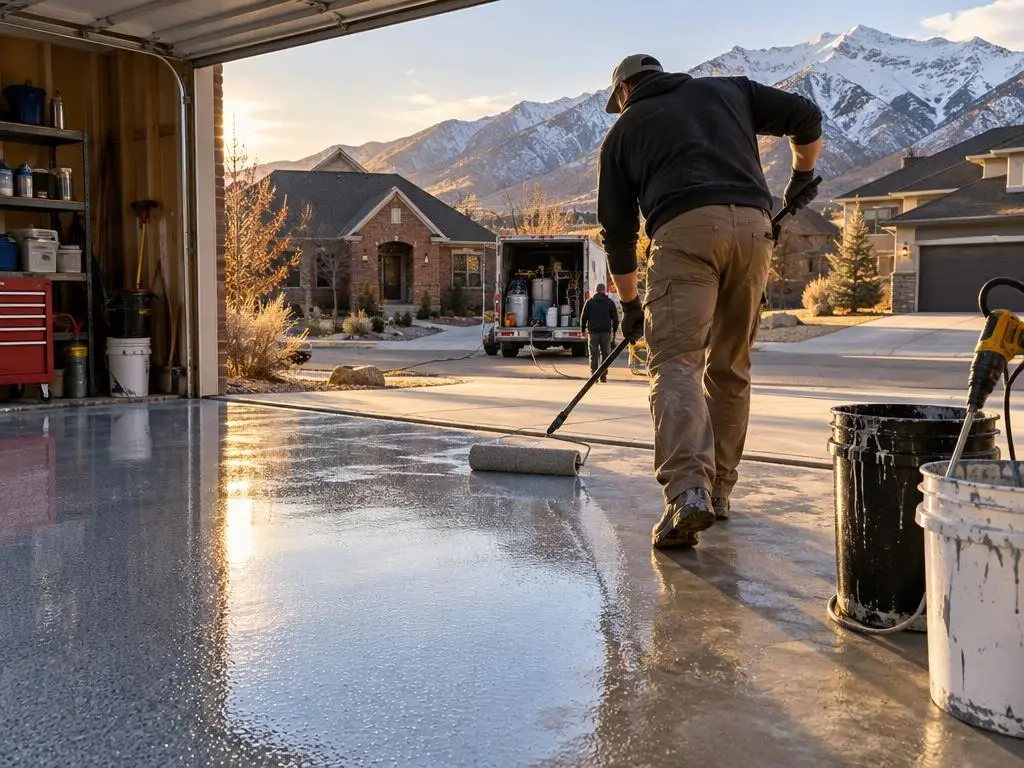
The layer you walk on takes the abuse, so we choose it carefully. For most garages that means a chemical-resistant polyaspartic or polyurethane topcoat over an epoxy base. In HomeGuide's ratings, plain epoxy earns only a poor-to-fair UV score and polyaspartic an excellent one, which matters when the door stays open on a bright July afternoon at 4,300 feet. The topcoat also controls grip. A glossy garage floor epoxy finish with no texture can be slick when snow melts off a car, so we add an anti-slip aggregate or a flake broadcast, with extra texture across the strip just past the door.
Older garages need more prep
Census survey estimates put about 25.4% of the city's housing units at 1939 or earlier. Many of those homes have detached garages with thin, uneven slabs, deep oil stains, porch paint, old patches and sometimes no vapor barrier. Newer garages are usually flatter and sounder, but freshly poured concrete still has a smooth, weak top skin that a coating cannot grip. Either way the process starts the same: diamond grinding with dust collection, degreasing, fixing cracks and spalls, then a moisture test. The test result decides whether the floor needs a moisture-tolerant primer.
Drainage gets a look as well. Many garages slope toward the door, some have a center drain, and a few older ones have low spots where water sits for days. Standing water is hard on any floor, so we point out low areas at the estimate. Small dips can be built up during repair. Larger drainage problems are noted in the quote so you can decide how to handle them before coating.
Choosing a finish
Most of our garage work falls into three looks. One solid color sealed under a clear coat is clean and simple. A full flake broadcast masks dust and tire tracks while giving the floor some texture. A partial flake is a lighter scatter for people who want some pattern without a busy look. Colors matter here too. Light grays show the white salt film less than dark colors, and mid-tone flake blends hide both salt and dust well. Our crew carries color chips to the visit, so you judge them under the lighting of your actual garage.
How garage use changes the system
Tell us what really happens in the garage. Daily parking, a weekend workshop with jack stands, a home gym with dropped weights, ski and bike storage, or a snowblower that lives by the door all point to different choices. Heavier use calls for more build or a tougher topcoat. A workshop may need oil and solvent resistance. A gym may need rubber mats in the lifting area so plates do not chip the surface. We write those details into the quote.
Living with the floor
Bob Vila puts standard epoxy at about 12 hours before walking and three days before driving, and HomeGuide notes that cars may need to wait 2 to 7 days depending on the product. Polyaspartic systems cure faster. We give you dates for walking, moving shelves back and parking based on the actual product and the temperature that week. After that, care is simple: rinse or squeegee through winter, sweep grit off, and use a mat under any car that drips oil.
If you plan to sell the house in a few years, a clean, sealed garage floor is something buyers notice on a walk-through. If you plan to stay, it is one of the few upgrades you use every single day. Either way, the floor will only be as good as the grinding, the moisture check and the topcoat behind it, and those are the parts of the job we never shorten.
What a Garage Job Includes
We coat the entire slab, starting at the door threshold and running to the back wall, and up the stem wall if you choose.
Diamond grinding
Grinding across the full floor, edges included, strips paint, sealers, stains and weak surface concrete, with dust collection.
Crack and spall repair
Cracks, chipped joints and freeze-thaw scaling near the door filled and ground flush.
Moisture testing
A reading on the slab before quoting, so the primer matches what the concrete is doing.
Base and build coats
Epoxy layers that bond to the ground concrete and fill small pits and pores.
Chemical-resistant topcoat
A polyaspartic or polyurethane finish chosen for road salt, oils and sunlight through the door.
Slip texture and stem walls
Anti-slip aggregate where wet tires land, plus optional coating on the low concrete walls around the slab.
Typical Epoxy Garage Floor Costs
| Job | Published range | Source |
|---|---|---|
| Installed epoxy, per sq ft | $4 to $10 | HomeGuide |
| One-car garage | $1,200 to $3,900 | HomeGuide |
| Two-car garage | $1,600 to $5,800 | HomeGuide |
| Three-car garage | $2,300 to $8,600 | HomeGuide |
| Polyurea garage coating, per sq ft | $5 to $10 | HomeGuide |
| Patching cracks and chips | $25 to $250 | This Old House |
These are national published ranges, not Salt Lake quotes. Old coatings, freeze-thaw damage and your chosen finish all shift the total, and you pay the amount shown on your written estimate.
From Estimate to Parking
1. Visit and test
We measure the garage, check the slab for moisture and note stains, cracks, scaling and old coatings.
2. Written quote
The written quote names the system, lists all the prep work and every coat, and gives the total.
3. Grind and repair
We diamond grind the slab, vacuum it, degrease it and patch it.
4. Coat
Base coat, color or flake, and a chemical-resistant topcoat, applied when the slab and air temperatures are right.
5. Cure and return
You get dates for foot traffic, for putting things back and for parking, set by the product and the conditions.
Why Choose Us for Epoxy Garage Flooring
Built around road salt
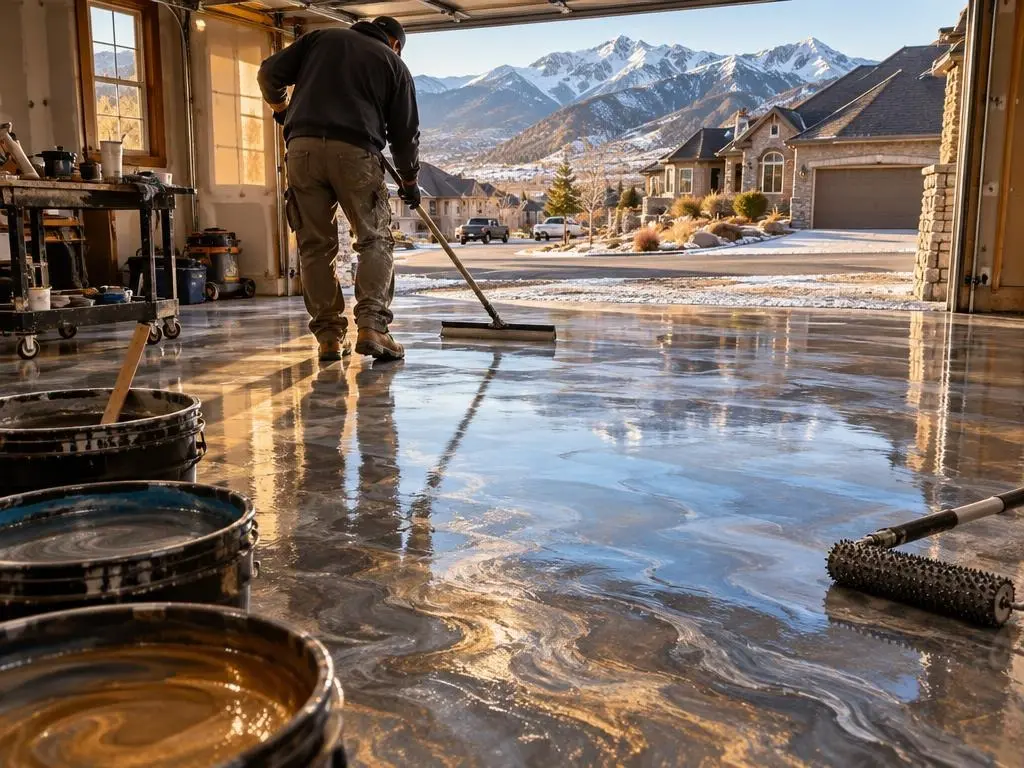
Topcoat and texture are chosen for months of slush and brine, not just for looks.
Old slabs welcome
We expect paint, oil and patchwork on older garage floors and price the prep honestly.
Clear cure dates
You know when you can walk, store and park before we start.
Epoxy Garage Flooring Questions
What lifespan can I expect from an epoxy garage floor in Salt Lake City?
HomeGuide puts solid epoxy at 10 to 20 years and thin water-based products at 3 to 5. In a garage that takes winter brine, the topcoat and the prep decide where a floor lands in that range. Grinding, a tough topcoat and rinsing salt off in winter all help.
Is winter too cold to coat a garage floor?
In a heated garage, often yes. In an unheated garage the slab can be too cold for the coating to cure properly, so we may suggest a faster-curing system or a milder week.
Do I have to empty the garage?
Yes, the floor needs to be clear for grinding and coating. Shelving that is bolted to the wall can usually stay if its feet are off the floor.
Will hot tires lift the coating?
Hot tire pickup is mostly a problem with thin kit coatings or floors that skipped grinding. A ground slab and a full-strength system bond far better than a rolled-on kit.
Is garage floor epoxy slippery?
Plain gloss gets slippery once it is wet. That is why we mix in anti-slip aggregate or flake, especially near the door where melting snow lands.
Epoxy Garage Flooring Service Areas
- Epoxy Flooring in Salt Lake City, UT
- Epoxy Flooring in West Valley City, UT
- Epoxy Flooring in Murray, UT
- Epoxy Flooring in Sandy, UT
- Epoxy Flooring in Draper, UT
- Epoxy Flooring in South Jordan, UT
- Epoxy Flooring in West Jordan, UT
- Epoxy Flooring in Taylorsville, UT
- Epoxy Flooring in Holladay, UT
- Epoxy Flooring in Cottonwood Heights, UT
- Epoxy Flooring in Millcreek, UT
- Epoxy Flooring in Midvale, UT
- Epoxy Flooring in Riverton, UT
- Epoxy Flooring in Herriman, UT
- Epoxy Flooring in Bountiful, UT
- Epoxy Flooring in North Salt Lake, UT
- Epoxy Flooring in Woods Cross, UT
- Epoxy Flooring in Centerville, UT
- Epoxy Flooring in Magna, UT
- Epoxy Flooring in Kearns, UT
- Epoxy Flooring in South Salt Lake, UT
- Epoxy Flooring in Bluffdale, UT
- Epoxy Flooring in Lehi, UT
- Epoxy Flooring in Park City, UT
- Epoxy Flooring in Tooele, UT
Get an Epoxy Garage Flooring Estimate
Free on-site estimates for garages in Salt Lake City and across the valley.